Tampilkan postingan dengan label capturing stills from video. Tampilkan semua postingan

Unfolding Film and Media Studies: "Postproduction", Freeze Frames, Death, Games, Augmented Reality and Biological Media

Diposting oleh good reading on Senin, 07 Mei 2012

Framegrab from Christiane F. - Wir Kinder vom Bahnhof Zoo/Christiane F. – We Children from Bahnhof Zoo (Uli Edel, 1981). Read Varpu Rantala's essay on studying this film via the link given below.

A quick little entry today, just to alert Film Studies For Free's e-bookworm readers of the latest, excellent update to FSFF's permanent list of links to online and openly accessible ebooks:

Jukka-Pekka Puro and Jukka Sihvonen (eds.), Unfolding Media Studies: Working Papers 2010 (Turku: Media Studies, University of Turku, 2011) PDF

Full contents are set out below.

  • Preface    7

    Film Studies
  • ILONA HONGISTO: Documentary Fabulation: Folding the True and the False    9
  • VARPU RANTALA: Samples of Christiane F.: Experimenting with Digital Postproduction in Film Studies    19
  • TOMMI RÖMPÖTTI: To the Freeze-Frame and Beyond    33
  • OUTI HAKOLA: Modeling Experience: Death Events and the Public Sphere    49
  • MARIA KESTI: Science on Fire! A Flying Torch Articulates    63

  • New Media
  • JUKKA SIHVONEN: Careless Saints: Notes for Research on the Aesthetics of Digital Games    69
  • TERO KARPPI: Reality Bites: Subjects of Augmented Reality Applications    89
  • TAPIO MÄKELÄ: Locative Games as Social Software: Playing in Object Oriented Neighbourhoods    103
  • JUKKA-PEKKA PURO: Turning Inside: Towards a Phenomenology of Biological Media    123
More aboutUnfolding Film and Media Studies: "Postproduction", Freeze Frames, Death, Games, Augmented Reality and Biological Media

More Blog Magic

Diposting oleh good reading on Rabu, 25 Maret 2009

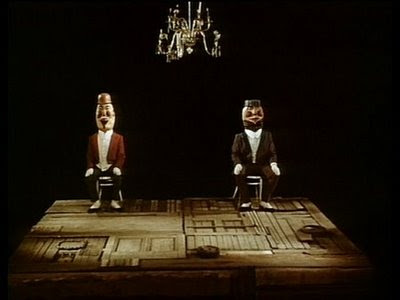
A quickie from Film Studies For Free today just to shout out about two of the best film studies blogs out there which, coincidentally, have very high-quality and worthwhile recent posts on films about duelling magicians:
It’s a way to understand films as wholes, dynamic constructions that shift their shapes across the time of their unfolding. Moreover, by examining things this closely, we can try to understand not only how this or that film works, but how this or that film relies on principles distinctive of a filmmaking tradition. Consider this another plug for poetics.

this short film is my starting point, and it reveals to me the challenges that lie ahead. Often we have to look carefully at films to come to terms with their idiosyncrasies, but Švankmajer’s work is particularly daunting in its concentration of allegory and allusion. [...] For eleven minutes [of this film], two magicians do battle, and their tricks require a montage of colliding images and a range of animation techniques: the two actors wear giant masks on their heads, probably papier-mâché, making them look like living, stringless marionettes, and Švankmajer manipulates them accordingly. The black backdrop allows a bunraku performance of sorts, with objects appearing to fly and float unaided through space; frame-by-frame animation moves the eyes of the masks; a shot of pixilation makes their bodies flit around the stage in a lightning fast chase. These are endlessly mutable bodies, but there is none of the joyous spectacle of Méliès’ filmed tricks here - the artifice is always signposted, never seamlessly suggestive, and the stolid expressions on the masked faces convey no fun, only procedure and routine. [links added by FSFF]

In addition to this (like Bordwell's) beautifully illustrated post, Dan's blog Spectacular Attractions has also taken up the challenge of Nicholas Rombes' 10 /40 / 70 film criticism exercise (see FSFF's post on this back on March 5). 10/40/70 is, according to Rombes:

[a]n experiment in writing about film: select three different, arbitrary time codes (in this case the 10 minute, 40 minute, and 70 minute mark), freeze the frames, and use that as the guide to writing about the film. No compromise: the film must be stopped at these time codes. What if, instead of freely choosing what parts of the film to address, one let the film determine this? Constraint as a form of freedom.

In recent posts, North has souped up the engine of the original exercise,

using a random number generator to choose three points from which to take my grabs, and then I have a limited amount of time to write a little about each frame. It’s a quick workout for the critical faculties, and hopefully a way of snapping a jaded blogger out of the comfortable routines of selecting only the most appropriate or illustrative images for a piece of writing

The results are both insightful and highly entertaining, as always with North's blog. Film Studies For Free urges you to check them out, as follows:

One last thought, the following movies may not all be about duelling magicians, but does anyone want to write about The Magician (1926), a horror film directed by Rex Ingram, or The Magician (1958), directed by Ingmar Bergman, or The Illusionist (2006), directed by Neil Burger, and make the highly completist Film Studies For Free one very happy blog indeed? Oh and there's the parody Magicians (2007), directed by Andrew O'Connor too. Any takers?

More aboutMore Blog Magic

Capturing in film criticism: Digital Poetics on frame grabs

Diposting oleh good reading on Kamis, 05 Maret 2009

North by Northwest (Alfred Hitchcock, 1959): A Classic 'Frame Capture Film'?

Here's a follow-up to yesterday's post. If you are a film studies teacher searching for more good ideas for student assignments, Film Studies For Free would like to recommend a little more weblog reading about classroom applications of film criticism exercises.

Today's gem is the 10/40/70 exercise invented by Nicholas Rombes (Chair and Professor of English at the University of Detroit Mercy- also see here) at his great weblog Digital Poetics. What is the gen on 10/40/70? According to Rombes, it's
[a]n experiment in writing about film: select three different, arbitrary time codes (in this case the 10 minute, 40 minute, and 70 minute mark), freeze the frames, and use that as the guide to writing about the film. No compromise: the film must be stopped at these time codes. What if, instead of freely choosing what parts of the film to address, one let the film determine this? Constraint as a form of freedom.

Rombes has posted three such experiments of his own to date (10 / 40 / 70 (Ocean's Twelve); 10 / 40 / 70 (The Conversation); (10 / 40 / 70): The Grudge and The Terror of Determinism). The results really show the benefits of the creative constraints involved: some rich and insightful writing is generated on the three very different films.

It strikes FSFF that this would be a very rewarding exercise to set for students.

For more on the practicalities, legalities, and methodological advantages and disadvantages of using frame captures in published or public work, see the following:
More aboutCapturing in film criticism: Digital Poetics on frame grabs