Tampilkan postingan dengan label Ingmar Bergman. Tampilkan semua postingan

New SENSES OF CINEMA: Haneke, Méliès, Hanoun, Bergman, Villaverde and more

Diposting oleh good reading on Kamis, 13 Desember 2012

Frame grab from Amour (Michael Haneke, 2012). Read Roy Grundmann's article on this film.

Film Studies For Free brings you glad tidings of a new issue of Senses of Cinema. All the contents are linked to below. FSFF hasn't pored over all of these yet, but so far the standout piece of interest may well be Haneke scholar extraordinaire Roy Grundmann's article on the Austrian filmmaker's latest film, which argues that
[Amour]’s particular take on the moral tale becomes clearer when we compare it to the moral tales of French New Wave filmmaker Eric Rohmer. As Rohmer explains, the conte moral does not pivot on characters’ actions, but on their inner conflicts and on how characters rationalize their motivations that arise from these conflicts. It has been noted that Rohmer’s films, like many examples of the Nouvelle Vague, are filled with dialogue in which the protagonists verbalize their feelings, perceptions, and mental states. Haneke’s new film harkens back to this pattern. 
FSFF also liked Marc Saint-Cyr's take on one of its favourite films Fanny and Alexander. And there's lots more that catches the eye in this issue.... 

Issue 65, 2012, Editorial 

Feature Articles
Great Directors
Special Dossier on Tasmania and the Cinema
Festival Reports
Cinémathèque Annotations on Film
Book Reviews
More aboutNew SENSES OF CINEMA: Haneke, Méliès, Hanoun, Bergman, Villaverde and more

Ingmar Bergman Studies

Diposting oleh good reading on Rabu, 29 Juni 2011

Updated September 19, 2011


Film Studies For Free brings you, below, a very long list indeed of links to online and openly accessible studies of the work of Ingmar Bergman. The list was especially inspired by hearing of the first of the three video studies above, via Adrian Martin, Corey Creekmur and Christa Fuller. This news led to the subsequent discovery of the rest of this amazing videographic trilogy on Bergman's films by Jonas Moberg. Update: FSFF has learned that these videos were devised by Thomas Elsaesser, during his year as Ingmar Bergman Professor at Stockholm University in 2007 in conjunction with the project "Ingmar Bergman in the Museum" (a summary of which is linked to below). Initially, seven of these videos were planned, to go with each of the chapters in the book Film Theory - An Introduction through the Senses. The research for all seven Bergman Senses Videos was carried out by Elsaesser, together with Anne Bachmann, a PhD student at Stockholm University, and Jonas Moberg then edited three of them. Sadly, time ran out on the project and the remaining four planned videos weren't completed.

Bergman scholars and fans should also know about Ingmar Bergman: Face to Face, the beautiful website of the Ingmar Bergman Foundation, which showcases and links to numerous further resources. Sight and Sound has also just featured a fascinating essay by Lena Bergman on her father's viewing habits in his unique private cinema, a converted barn on Fårö, the Baltic island where he lived until his death in 2007. This year’s Bergman Week festival takes place in the cinema on Fårö from 28 June to 3 July. Television viewers in the UK might, in addition, like to hear that Film4 will show 16 Ingmar Bergman films in a series beginning next week. Yay!

If FSFF says so itself, the below list is probably one of its best ever (do scroll right down for all the videos). It was certainly one of the most rewarding to compile... It hopes you will find it in equal parts enjoyable and useful.


    Liv Ullmann at the Bergman Week 2010, speaking about the filming of Face To Face with Ingmar Bergman. She talks about the relationship between a director and his actors, and specifically the scene when her character commits suicide in the film.

    Wim Wenders talks about Ingmar Bergman

    Agnes Varda talks about Bergman.

    David Stratton talks about Ingmar Bergman.

    Bergman Center interviews American director John Landis about Ingmar Bergman at Venice International Film Festival.

    Bergman Center interviews French actor Jean-Marc Barr about Ingmar Bergman at Venice International Film Festival.
    More aboutIngmar Bergman Studies

    30+ articles from the Journal of Aesthetics and Culture

    Diposting oleh good reading on Kamis, 26 Mei 2011

    Frame grab from The Wind (Victor Sjöström, 1928). Read Bo Florin's article on this film
    [Traditionally, aesthetics] has been based on national perspectives and contexts, as well as contained within the limits of specific disciplines. However, the changing society has made this focus all too narrow. Due to globalization, media and territories merge and move in new ways, where regional, national, international, and global perspectives increasingly integrate. New contexts and new aesthetic strategies are also created, and traditional boundaries and hierarchies become transgressed, for example, between high brow and popular culture, or between art and technology. Aesthetics as well as culture thus need to be discussed and interpreted across the disciplines, through different media, over territorial borders. Finally, this is also a strong argument for Open Access publishing: to constitute a global platform and an interface for interdisciplinary discourse—free for anybody to read. [from first JAC Editorial by Astrid Söderbergh Widding, Lars Gustaf Andersson and John Sundholm]
    Film Studies For Free had been meaning to post something about the Journal of Aesthetics and Culture for quite a while. It's an online open access journal, hence one very much after this blog's's heart, with a high percentage of very good quality film-studies related articles that FSFF has frequently linked to on Twitter.

    Today, JAC published an excellent dossier on Transnational Cultural Memory, an event which provided a wonderful prompt to gather together, in one place, links to everything that JAC has published to date. And below, that is just what you will find.

    FSFF has also added JAC to its permanent listing of excellent, Open Access film and moving image studies journals

    Vol. 1 (2009)
    Vol. 2 (2010)

    Vol 3 (2011)

    More about30+ articles from the Journal of Aesthetics and Culture

    "A fusion of life and dream": In memory of John Orr

    Diposting oleh good reading on Minggu, 19 September 2010

    Image from Dogville (Lars von Trier, 2003). This  film topped John Orr's list of favourite films in 2003 (here are his 2004, 2006, 2007 and 2009 lists)
    What is trauma if not, as in the original Greek, a kind of wound? In cinema, though, it is something more: a wound that seldom heals, a deep wounding of body and soul from which, often, the subject does not recover. Hence, the critical formula for the outcome of the trauma picture: at the least, significant damage; at the most, violent death.

    If film horror often sources the supernatural, film trauma focuses on the fears of the natural world. What is out there as waking nightmare in a dangerous world is often a mirror of what is hidden in here, in the human heart. The monsters that horror films project onto the screen are often the monsters of our dream worlds. The wounding events of the trauma film are by contrast a fusion of life and dream.

    In film, there is no absolute borderline between these opposites – human trauma and supernatural horror  but the question of emphasis, one way or the other, is crucial: the threat of aliens, mutants, werewolves, monsters, robots, slasher killers, vampires et alia, or the threat of evil that is here and now, that is contingent and recurrent in the life-world, yet also seems onscreen to inhabit the world of dream. Horror is, thus, the popular genre of superhuman evil, trauma its human and dreamlike subset. [John Orr, 'The Trauma Film and British Romantic Cinema 1940-1960', Senses of Cinema, Issue 51, 2009]

    Film Studies For Free was very sad to hear, via Dina Iordanova's website, of the death of influential film theorist and scholar John Orr.

    Appointed as a lecturer in Sociology at the University of Edinburgh in 1967, Orr began teaching film and cultural studies in that department in 1984. A few years later, he founded, with John Ellis, the joint honours film course for Sociology and English Literature. From 1998 onwards, he taught on the MSc in Film Studies, based in the School of Literatures, Languages and Cultures.

    Best known for his pioneering work on the sociology of film and art, Orr was author of Cinema and Modernity, Contemporary Cinema, The Art and Politics of Film and Hitchcock and 20th Century Cinema. He also co-edited important works on Andzrej Wajda and Roman Polanski and had written recent essays on Ingmar Bergman, Terrence Malick, and Dogme 95. His most recent book was Romantics and Modernists in British Cinema (Edinburgh University Press, 2010). He had recently retired from his post as Professor Emeritus in Social and Political Studies at Edinburgh, but was still very active in his research and publishing on cinema.

    Orr was both prolific and very generous with his work. In recent years, he published a number of significant essays online, many of which set out in depth his brilliant thinking on trauma, fright, and paranoia in the cinema. Below, in tribute to and with gratitude for his work, both on and offline, FSFF has gathered links to those essays.

      More about"A fusion of life and dream": In memory of John Orr

      Archives and Auteurs: conference papers online

      Diposting oleh good reading on Kamis, 12 November 2009


      As part of the Arts and Humanities Research Council-funded research project on 'The Cinema Authorship of Lindsay Anderson' (see detailed project outline), a conference on Archives and Auteurs was held at the University of Stirling from 2nd - 4th September 2009. The conference brought archivists, academics, curators and researchers together to discuss the ways in which the study of the archives of filmmakers and the film industry can provide new perspectives and insights into the history of cinema.

      Film Studies For Free was delighted to see that the excellent papers from the conference are now freely accessible online at the Stirling University website.

      Direct links to open pdf files are given below. In addition, check out Kathryn Mackenzie's wonderful blog -- Archives and Auteurs -- devoted to this project. A selection of Anderson's photograph albums from 1940s and 1950s have been made available on the University of Stirling Archives flickr pages. These albums provide a rich visual record of Anderson's early years as a filmmaker, documenting the early industrial films he made in Wakefield, his trips to the Cannes Film Festival and his contribution to Free Cinema. Those interested should also read this related article by Isabelle Gourdin-Sangouard, 'Creating Authorship? Lindsay Anderson and David Sherwin’s collaboration on If.... (1968)', Journal of Screenwriting, Volume 1, Number 1, 2010. And finally, Moving Image Source published a great article on Anderson (August 14, 2008) by Steve Erickson, entitled 'Anarchy in the U.K': 
      More aboutArchives and Auteurs: conference papers online

      More Blog Magic

      Diposting oleh good reading on Rabu, 25 Maret 2009

      A quickie from Film Studies For Free today just to shout out about two of the best film studies blogs out there which, coincidentally, have very high-quality and worthwhile recent posts on films about duelling magicians:
      It’s a way to understand films as wholes, dynamic constructions that shift their shapes across the time of their unfolding. Moreover, by examining things this closely, we can try to understand not only how this or that film works, but how this or that film relies on principles distinctive of a filmmaking tradition. Consider this another plug for poetics.

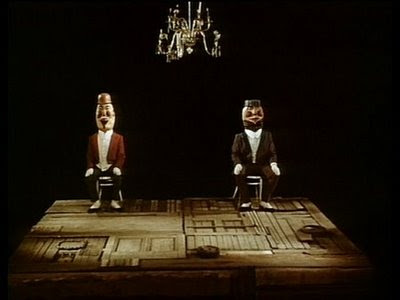
      this short film is my starting point, and it reveals to me the challenges that lie ahead. Often we have to look carefully at films to come to terms with their idiosyncrasies, but Švankmajer’s work is particularly daunting in its concentration of allegory and allusion. [...] For eleven minutes [of this film], two magicians do battle, and their tricks require a montage of colliding images and a range of animation techniques: the two actors wear giant masks on their heads, probably papier-mâché, making them look like living, stringless marionettes, and Švankmajer manipulates them accordingly. The black backdrop allows a bunraku performance of sorts, with objects appearing to fly and float unaided through space; frame-by-frame animation moves the eyes of the masks; a shot of pixilation makes their bodies flit around the stage in a lightning fast chase. These are endlessly mutable bodies, but there is none of the joyous spectacle of Méliès’ filmed tricks here - the artifice is always signposted, never seamlessly suggestive, and the stolid expressions on the masked faces convey no fun, only procedure and routine. [links added by FSFF]

      In addition to this (like Bordwell's) beautifully illustrated post, Dan's blog Spectacular Attractions has also taken up the challenge of Nicholas Rombes' 10 /40 / 70 film criticism exercise (see FSFF's post on this back on March 5). 10/40/70 is, according to Rombes:

      [a]n experiment in writing about film: select three different, arbitrary time codes (in this case the 10 minute, 40 minute, and 70 minute mark), freeze the frames, and use that as the guide to writing about the film. No compromise: the film must be stopped at these time codes. What if, instead of freely choosing what parts of the film to address, one let the film determine this? Constraint as a form of freedom.

      In recent posts, North has souped up the engine of the original exercise,

      using a random number generator to choose three points from which to take my grabs, and then I have a limited amount of time to write a little about each frame. It’s a quick workout for the critical faculties, and hopefully a way of snapping a jaded blogger out of the comfortable routines of selecting only the most appropriate or illustrative images for a piece of writing

      The results are both insightful and highly entertaining, as always with North's blog. Film Studies For Free urges you to check them out, as follows:

      One last thought, the following movies may not all be about duelling magicians, but does anyone want to write about The Magician (1926), a horror film directed by Rex Ingram, or The Magician (1958), directed by Ingmar Bergman, or The Illusionist (2006), directed by Neil Burger, and make the highly completist Film Studies For Free one very happy blog indeed? Oh and there's the parody Magicians (2007), directed by Andrew O'Connor too. Any takers?

      More aboutMore Blog Magic